Clinical research
Trial design, endpoints, protocol alignment, missing outcomes and the reporting of clinical and observational studies.
 MANUSCRIPT
Independent scientific review
An early technical review can save months of back-and-forth in peer review.
We review the statistics and code behind life sciences manuscripts, check every claim against the evidence, and help correct the paper through tracked edits and proposed analysis fixes.
01 / Scope of review
We bring expertise in scientific communication and peer review to work ranging from clinical trials to computational biology. We review the paper alongside its figures, supplements and analysis code.
Trial design, endpoints, protocol alignment, missing outcomes and the reporting of clinical and observational studies.
We identify statistical issues in model choice, assumptions, missing data, multiplicity and uncertainty, then explain how they could affect the conclusions.
We inspect research codebases, trace reported results to the code that produced them, and can submit pull requests with proposed fixes directly to your repository.
We examine omics pipelines, model validation, data leakage, batch effects and whether the methods are described well enough to reproduce.
We evaluate every claim in the paper, from abstract to figure captions, against the underlying analyses or cited literature. We flag claims that need stronger support or more precise wording.
You receive tracked manuscript edits that improve language, readability and scientific precision, correct inconsistencies and align claims with the evidence.
02 / How we harness frontier AI
We deploy bespoke agents built on advanced AI models. For complex studies, they can run thousands of checks across data, figures and code. Automating these checks helps keep your review costs down.
Compare cohort counts across analysis files and tables. Flag missing values, duplicate records and unexpected exclusions.
Compare plotted values with analysis outputs. Check labels, units and whether captions describe the right analysis.
Follow reported results back to the scripts that generated them. Flag differences in filtering, model settings or analysis inputs.
An expert leads every review. Your reviewer sets the scope, directs the agents and checks the findings that could change your conclusions or require substantial revisions before delivering the report.
03 / Sample reviews
Two independent reviews of public research. Each assesses the paper’s contribution, prioritises revisions and shows the checks behind the findings.
Clinical research · Published article
Reconciles the article, protocol and registry. Rebuilds rare-event comparisons from the appendix and examines how incomplete follow-up affects interpretation.
Read the COV009 reviewGenomics · Preprint
Joins isolate-level supplementary tables to check clinical outcomes, traces a figure discrepancy to the underlying counts and tests sample-ID handling in the linked pipeline.
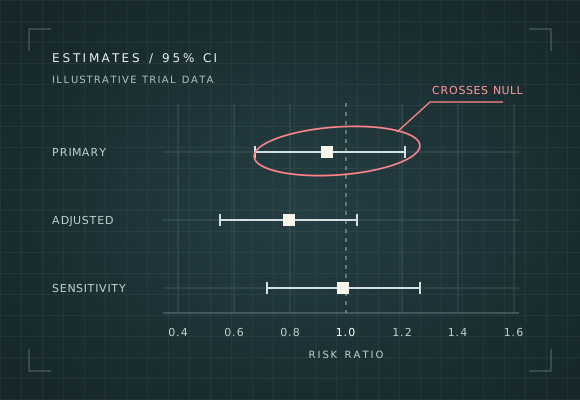
Read the DiSCoVeR reviewIllustrative clinical example using fictional results.
“The intervention significantly reduced hospital admissions and should be adopted in routine care.”
The intervention significantly reduced hospital admissions and should be adopted in routine care. Hospital admissions were lower in the intervention group (risk ratio 0.82, 95% CI 0.62–1.08). The interval includes no difference between groups. These findings warrant further evaluation before routine implementation.
Reviewer’s reasoning. The confidence interval includes 1.0, so the estimate remains uncertain. We replace the claim of statistical significance, report the estimate and interval, and revise the recommendation. We then check the abstract, Results, figure caption and Discussion for agreement.
The team receives the proposed wording as tracked changes, alongside the supporting finding. Revisions that alter scientific interpretation are agreed with the authors.
04 / Large studies
No supplement is too big. We review large datasets, multi-cohort analyses and extensive figure sets, tracing results across the paper, supplement and code.
05 / Process
We identify the issues, help correct the manuscript and work with your team through the agreed revisions to submission.
Tell us the study type, target journal if selected, and submission date. We agree the materials, technical priorities and timeline.
Your reviewer directs AI agents to check the manuscript claim by claim and examine the agreed analyses, code and supporting materials.
We provide a prioritised report and tracked manuscript edits, reconcile claims and captions, and propose statistical or code corrections. Where appropriate, we submit pull requests. Changes affecting scientific interpretation are agreed with your team.
We work with you through the agreed revisions and check the final manuscript, figures and supplements for consistency before submission.
Pricing
£1,200
Typical fixed project fee
We agree the materials, deliverables, timeline and fixed fee before starting. The fee covers the agreed manuscript through submission.
New experiments, substantial new analyses or a changed research question are quoted separately.
Discuss your manuscript06 / Enquiries
We welcome enquiries from research groups in Saudi Arabia and internationally. A short outline of your study, its current stage and your submission window is enough to get started.
Please keep manuscript files and patient data out of your initial enquiry. We can agree how to share review materials once we’ve scoped the project.
[email protected]